
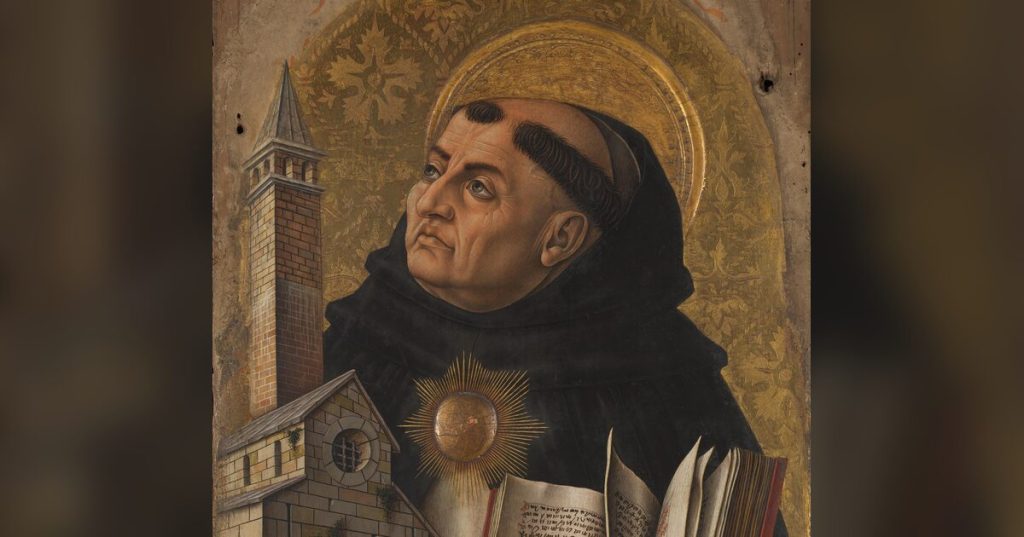
Catholic doctrine on immigration has a firm basis in theology and philosophy. St. Thomas Aquinas, in the Summa Theologiae (I-II, q. 105, a. 3), treats the judicial precepts of the Old Law on foreigners. He distinguishes three relations, not one rule.
The first is the traveler passing through. The second is the newcomer who comes to dwell in the land. In both cases the Law made kind provision: the stranger was not to be molested.
The third is the foreigner who wishes to be admitted entirely to the fellowship of the people and to their mode of worship. Quoting Aristotle, the Angelic Doctor notes that in most ancient societies, citizenship was not conferred until after the second or third generation.
“The reason for this was that if foreigners were allowed to meddle with the affairs of a nation as soon as they settled down in its midst, many dangers might occur, since the foreigners not yet having the common good firmly at heart might attempt something hurtful to the people,” he writes.
This of course included the Israelites of the Old Testament. For the sake of brevity and focus, we will address that part of it in full in a separate post.
The order observed by these ancient societies provided peaceful residence to any foreigner who chose to dwell in the land and keep the civic religion. But to dwell in the land was not yet to share in ruling it.
Citizenship, with all its incumbent rights and duties, was only conferred on those who were fully incorporated into the society: who knew their neighbors and regarded them as their fellows; who rejected the prejudices of their former country against their new one; who knew the customs, beliefs, and laws of the land they inhabited and no other.
The legal path to American citizenship follows the same pattern, albeit less strictly. A prospective citizen must learn the Constitution and the laws, and must swear an oath renouncing allegiance to his country of origin, pledging allegiance to the United States, and accepting the obligation to serve the country in a time of crisis.
But in this era of unchecked migration, these principles have largely been disregarded. We have allowed tens of millions of people from all over the world to enter our country who do not have the “common good firmly at heart.” Hundreds of thousands have come from adversarial nations, or ones that are plagued by terrorism, drug and human trafficking. Many migrants see the United States as an economic zone to take from rather than a nation with a people to join, living apart from American society and sending the fruits of their residence here elsewhere.
A well-ordered policy receives the immigrant who takes his neighbor as a fellow, joins the community, and works for the common good of his new home, with his loyalty here and not elsewhere. Civil authority has the right and the duty to establish that order. The Church ought to recognize the charge this lays on civil servants, pray for them, and preach the teaching in full, rather than rebuke them for exercising an office she herself acknowledges.
